
ndn wars are alive, and … well?
2010
Email us to revise your entry or request it to be deleted.
Genre
Keywords/themes
Media type
Filming locations
Sarnia, Ontario, Canada
Alternate titles
ndn wars are alive, and … well? Gallery Lambton, Sarnia edition
Country of origin
Canada
Technical specs
Colour
Content Warnings
Unreviewed
Want to add a content warning? Email us!
Images
Description
Words by producer Paul Couillard: I first met Aiyyana holding court—there really is
no better description for it—at the kitchen table of grunt Gallery in Vancouver, where
she played an integral part in nurturing a burgeoning contemporary native art scene.
She struck me then as a strong woman very much in her element, exerting her influence
and contributing to the development of a vibrant, evolving community in a myriad of
both subtle and strident ways. She was generous yet uncompromising, forceful but also
vulnerable. Years later, I remember meeting with her at her apartment, where she gave
me a careful look up and down before pronouncing that she trusted me enough to allow
me to produce her work. By posing the possibility of a working relationship in this
admittedly imperious manner, she was making clear that for her, producing performance
art was no casual matter of simply providing entertainment or furthering career goals:
it was a sacred passion that should only be entrusted to thoughtful and respectful
contexts.
I was eventually responsible for producing two iterations of a performance Aiyyana
titled ndn wars are alive, and … well? The first version was presented as part of
FADO’s IDea series in Toronto’s Trinity Bellwoods Park in 2006 in the context of the
7a*11d International Festival of Performance Art. The work had two key components.
First, a looped documentary videotape, compiled by Aiyyana Maracle with La Mathilde,
chronicled the troubled relationship between the Crown and Canada’s Indigenous populations,
pointing to the ongoing resistance to a colonial, settler occupation that most non-Indigenous
Canadians imagine to be simply a matter of historical record. For the Toronto version,
the videotape was projected large onto the grassy slope of a hill, and on a smaller
scale, onto the side of a white tent erected on the grounds. The second element was
Aiyyana’s presence. Appearing in various animal masks, Aiyyana manifested a shadowy
figure against the night backdrop, a trickster presence darting among the trees or
silhouetted on the ridge of the hill. Eventually, Aiyyana appeared as a human figure
and began a slow spiral dance across a large section of ground. Although Toronto was
not a traditional Mohawk territory, this slow, careful choreography offered a pointed
assertion of Indigenous presence on contested land. Ethereal, almost ghostly, the
image of Aiyyana stepping and sounding left a lasting imprint. Certainly this occupation
was symbolic, metaphorical, but it was also undeniably material: an Indigenous body
claiming both a physical territory and a cultural space of ritual in a location thought
to be fully governed and policed by (post?)colonial infrastructures. The image she
created has always had ambiguous resonances for me. Looking through one set of eyes,
I see a lonely, ephemeral figure conjured up out of a cold, windswept night, like
a ghost of a past that never quite existed. At the same time, I also feel a powerful
medicine, an insistence that as long as even one figure can persist in calling up
this dance, in renewing a claim of resistance, the questions of dominance and territory
that haunt our country remain unsettled and demand renegotiation. The playful appearance
of the masked figures leaves a lingering sense of exhilaration; the sombre, determined
dancer, a sense of dignified sobriety.
The second version of this performance was presented outside Gallery Lambton (now
moved and renamed the Judith & Norman ALIX Art Gallery) in Sarnia in 2010 as part
of a performance event called Present Response. This piece was staged quite differently,
presented from the early evening to dusk of a gloomy, occasionally rainy spring day.
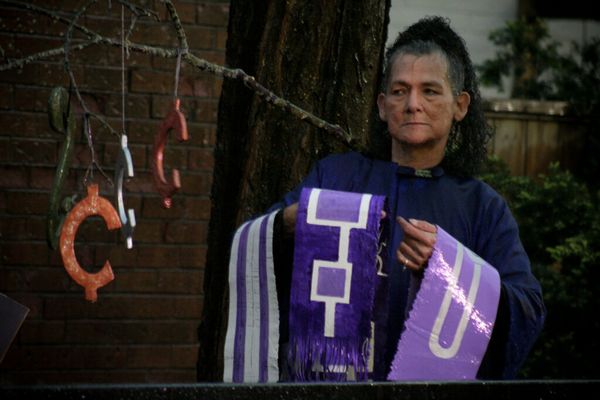
The video was again prominent, projected onto a brick wall behind the artist, slowly
becoming visible as the sky darkened, and also playing on a monitor installed to one
side of the outdoor tableau. Aiyyana’s presence was confined to a narrow patch of
sod temporarily laid down in a fenced-off area beside the walkway leading up to the
gallery. Dotting the grass were rows of miniature flags, sporting symbols of the Six
Nations. Over the course of the three-hour performance, these flags were decimated
by a white male figure sporting a weed whacker while Aiyyana, an imposing, silent
presence dressed in a colourful robe, stood her ground at the far end of the space.
Sarnia, traditionally Chippewa territory, is no less marked by colonial possession
than Toronto. In this version of Aiyyana’s ndn wars…, what we have come to see as
the ‘normal’ status of an ordinary urban space—the entrance to a gallery and a shopping
mall, part of the downtown geography of a long-established Canadian city—was reconfigured
to reveal another part of its human history, to bear witness to an ownership status
that, however widely accepted and normalized, remains contested. And if only the faintest
traces of the projection could be detected against the backdrop of Aiyyana’s body
and the brick wall beside her, does this not also speak to the underlying question—of
what we are able to see of what is, even if invisible, nevertheless there?
By the time Aiyyana presented the first version of the work in 2006, she had left
Vancouver and taken up an unpaid position as a Visiting Scholar at McGill University
in Montreal. In 2010, when she presented the second version, she had returned to the
Six Nations reservation where she had been born, on the Grand River near Ohsweken
in southern Ontario. Each of these moves required a corresponding reinvention of her
self-image. Neither of these transitions was easy, and she struggled with both financial
and mental health challenges. Despite these adversities, she managed to cultivate
close familial and community ties, living with one of her sons and becoming an important
advocate for trans and gender nonconforming youth. She became the co-facilitator of
Gender Journey, a peer support group run out of the Grand River Community Health Centre.
She was also a proud great-grandmother several times over. Respectful of the capital-G
Grandmothers who oversaw her journey, she also brought a deep sense of commitment
and sensitivity to her own role as a grandmother and elder. Commenting on the role
she found herself inhabiting in this period of her life, she reflected, “There is
no mirror for who I am. From necessity I became the mirror for all the younger ones.”[6]
Aiyyana’s adaptability and resilience reflected her understanding that we as humans,
and the cultures we create, are always evolving. In her own words—words she not only
wrote but also found ways to embody and live by—
For people and culture to survive, they need to evolve continually. What we as Indigenous
people need to do is scrape off the stagnated scum from the culture in which we presently
find ourselves immersed, pick up the residue of our historic cultures, and reblend
the cultural pattern of who we really are today by following the roots inherent in
the laws, values, and principles embodied in the old ways. This we need to do so that
our grandchildren may find their way through to tomorrow with their humanity intact.[7]
Email us to revise your entry or request it to be deleted.